





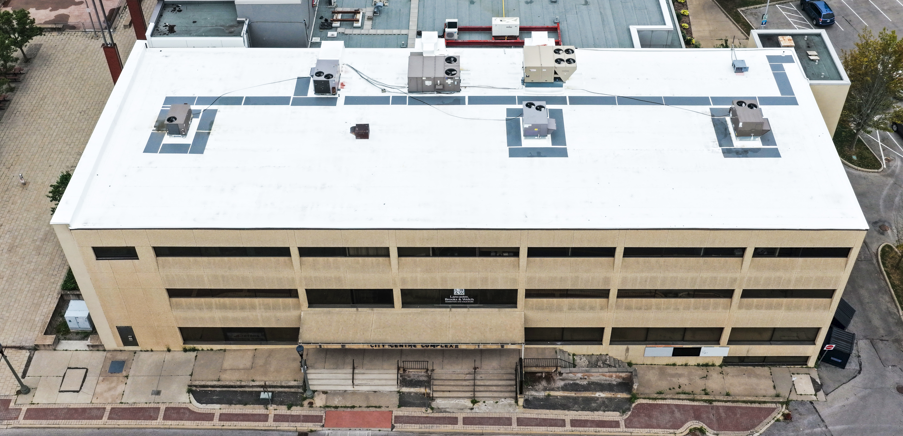
PVC roofing is one of the most widely used single-ply roofing systems for commercial and industrial buildings across North America. Known for its durability and long-term performance, it is one of the common choices when it comes to flat and low-slope roofing applications.
However, many building owners still ask the question: what is a PVC roofing membrane, and what benefits does it offer?
Understanding what PVC roofing is, how it works, and why it might be chosen over other single-ply roofing systems can help decision makers select a roofing solution that aligns with their performance needs and long-term goals.
What Is a PVC Roofing Membrane?
A PVC (polyvinyl chloride) roofing membrane is a type of single-ply roofing material used to protect flat and low sloped roofs from water, weather, and environmental exposure.
PVC roofing is manufactured as a flexible sheet and installed across the roof surface as part of a flat roofing system. These sheets are joined together through heat-welded seams, creating a strong durable bond that helps keep the roof sealed over time.
PVC roofing membranes are commonly used in commercial and industrial roofing applications because they provide reliable, long-term protection for buildings.
How PVC Roofing Works
- Installed in large flexible sheets across the roof surface.
- Uses heat-welded seams to form a strong, sealed connection.
- Creates a layer which helps keep water out and protects the building.
- Designed to handle sun, rain, temperature changes, and other environmental exposures.
Goliath PVC: Key Features and Benefits
Compared to other single-ply roofing systems, Goliath PVC offers several advantages, making it a reliable long-term roofing solution for commercial and industrial buildings.
- Industry leading top-ply thickness and acrylic coating provide world class performance.
- Robust construction delivers enhanced moisture and cold resistance.
- Excellent flexibility to support performance in all climates.
- Can be easily welded to provide superior seam strength and watertight performance.
- Strong resistance to environmental elements such as UV radiation, Ozone, and microorganisms.
- Highly reflective surface helps reduce heat transfer through the roof into the building’s interior.
- Goliath is the only Canadian made PVC.
Check out all Goliath PVC Key Benefits.
PVC vs Other Single-Ply Roofing Systems
When comparing flat roofing systems, PVC is often evaluated alongside other single-ply roofing membranes such as TPO and EPDM. Even though these systems all serve a similar purpose, there are key differences in how they perform over time.
Performance Considerations:
- PVC and TPO use heat-welded seams, while EPDM uses adhesive or taped seams, which could lead to more maintenance over time. PVC also offers the strongest heat-welded seam performance in the industry.
- PVC offers strong resistance to chemicals, grease, and rooftop containments.
- TPO is often selected for lower initial cost, while PVC is chosen for its longer lifespan and lower life-cycle cost over time.
Explore our PVC vs TPO and PVC vs EPDM comparison articles.
Choosing the right roofing system is a critical decision for any commercial or industrial building. By understanding what PVC roofing is and the benefits it offers, building owners can make informed decisions that align with their performance goals.
We hope to build your confidence to specify Goliath. Not because it is made in Canada, but because it is a premium PVC membrane in the market. We engineered our membrane to not only meet but exceed industry standards. Goliath by CGT has a proven track record across North America and is recognized for its superior quality, durability, and performance. It just happens to be proudly manufactured in Canada!